
Monks, moguls, and nine-figure price tags
While most of us were stressing over mortgage rates, billionaires like Eric Schmidt, Alex Karp, maybe even Jeff Bezos, were casually dropping hundreds of millions on everything from a Gulf Coast palace to a literal monastery. Welcome to the wild world of ultra-luxury real estate in 2025, featuring the most expensive residential real estate deals of the year.
This year’s biggest real estate deals weren’t just about square footage and ocean views. They involved mystery buyers, a tech billionaire moving into a monastery (yes, really), and enough money changing hands to fund a small country’s GDP.
Grab your champagne flute (or your coffee mug) and let’s dive into the most extravagant home purchases of the year.
1. The $225 million Florida flex: Naples’ record-shattering sale
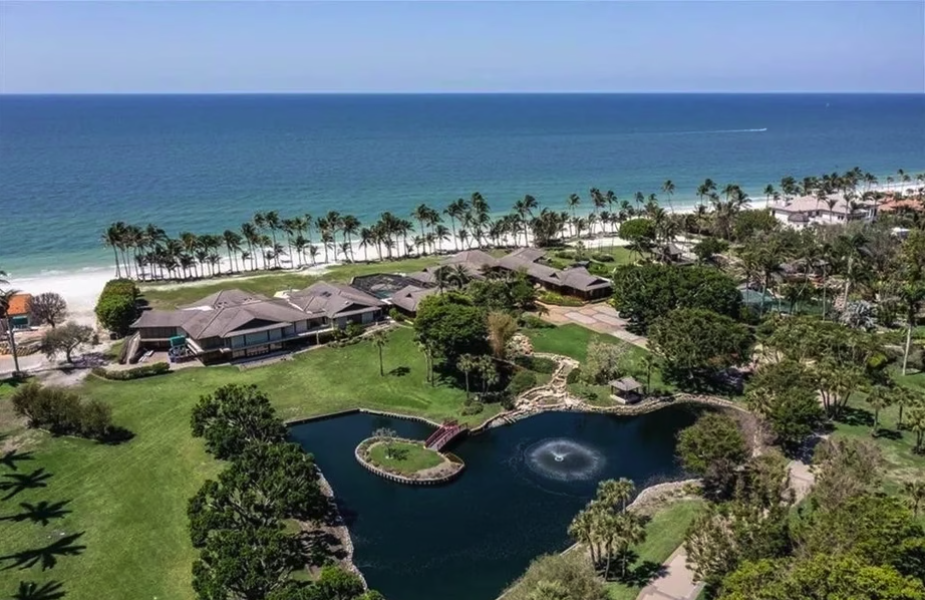
Picture this: 15 acres of pristine Gulf Coast beachfront in Naples, Florida. Not just any beachfront—we’re talking 800 feet of it. That’s longer than two-and-a-half football fields of “this is all mine” stretching along one of America’s most exclusive stretches of sand.
The property, pieced together over decades by late Canadian billionaire Michael DeGroote (trucking and waste management money, for those keeping score), finally sold in April for a cool $225 million. That’s the second-most expensive home ever sold in the United States, beaten only by hedge fund titan Ken Griffin’s $238 million Manhattan penthouse.
Here’s what that kind of money gets you: three separate homes on the compound, including an 11-bedroom, 16-bathroom main mansion. One of the houses—built in 1938—survived Hurricane Ian without a drop of water damage, which is either exceptional construction or divine intervention, depending on who you ask.
The kicker? The family originally wanted $295 million. Imagine negotiating a $70 million discount and still spending more than most people will earn in multiple lifetimes.
Oh, and the buyer? Completely anonymous. Because when you spend that much, apparently the last thing you want is anyone knowing about it. The listing agent called it “a once in a lifetime, singular opportunity to build a true legacy,” which is real estate speak for “you’ll literally never see anything like this again.”
2. Alex Karp’s $120 million monastery purchase: The Palantir CEO who bought St Benedict’s in Snowmass, Colorado
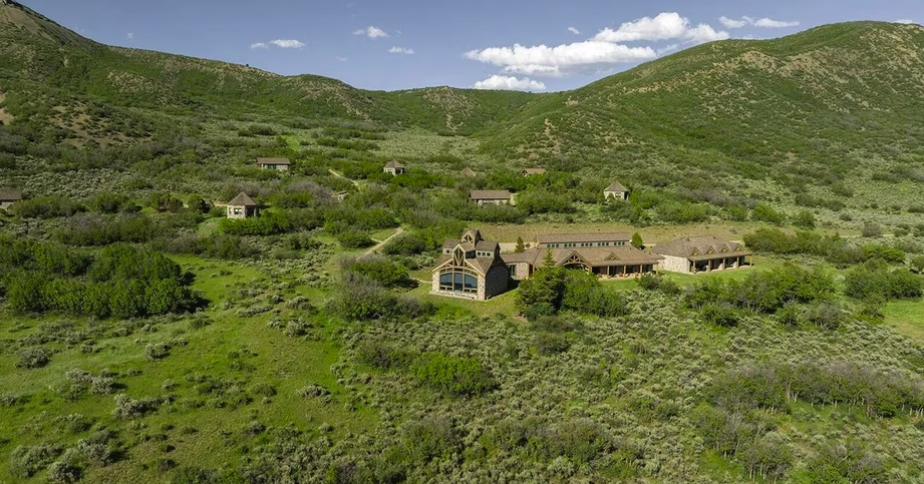
Now here’s a plot twist nobody saw coming: Alex Karp, the eccentric CEO of Palantir Technologies, decided the perfect place to unwind from building surveillance software was… a 3,700-acre monastery.
Not just any monastery. St Benedict’s in Snowmass, Colorado – near Aspen – was home to Trappist monks for nearly 70 years. We’re talking about men who took vows of silence, grew their own food, and rose at 3:15 AM for prayer.
The property includes the actual 24,000-square-foot monastery building (designed to look like a 12th-century French abbey), a chapel, library, guest cabins, and enough land to run a cattle operation. There are three creeks running through it, 1,200 acres of irrigated meadows, and some of the most valuable water rights in the Roaring Fork Valley.
Alex Karp bought the St. Benedict’s Monastery for $120 million—Colorado’s priciest home sale ever. The monks had originally hoped for $150 million when they listed it in 2024, but ultimately decided Karp was a “conservation-minded buyer,” which probably means he promised not to turn it into a theme park.
The final mass at St. Benedict’s took place on January 11, 2026. After that, instead of chanting monks at dawn, the valley will have Alex Karp—known for his intense cross-country skiing habit and philosophical tangents. The Palantir CEO’s purchase represents one of the most unique ultra-luxury real estate acquisitions of 2025.
3. Eric Schmidt and Wendy Schmidt buy the Spelling Manor: LA’s $110 million icon in Holmby Hills
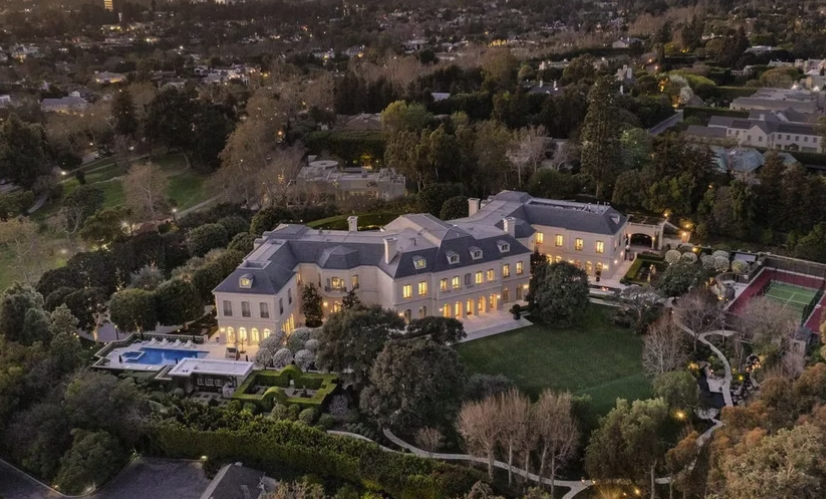
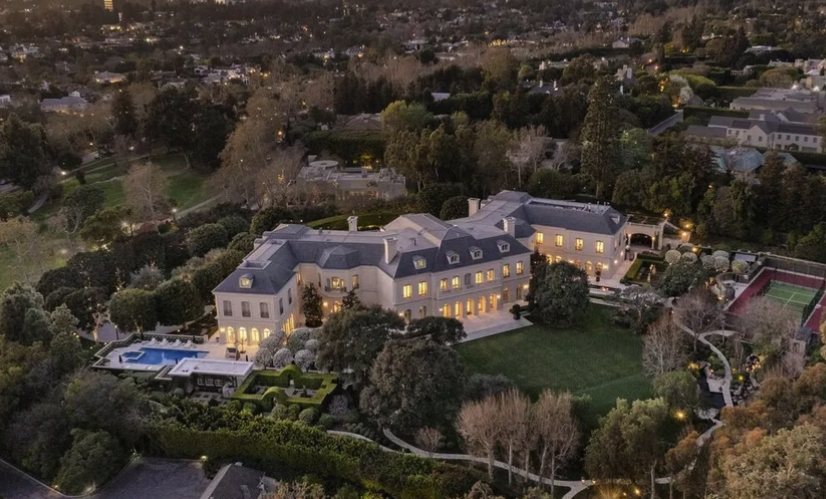
If you’ve ever watched old episodes of MTV Cribs or toured celebrity homes in your mind, you know about the Spelling Manor. Built by legendary TV producer Aaron Spelling (Beverly Hills 90210, Charlie’s Angels, Dynasty), this French château knockoff in Holmby Hills is larger than the White House. Not similar in size—literally bigger. At 56,500 square feet with 123 rooms, it’s basically a small hotel masquerading as a house.
The place has 14 bedrooms, 27 bathrooms, a bowling alley, a nightclub, a wine cellar, screening room, gift-wrapping room (because apparently wrapping gifts in a regular room is for peasants), and a humidity-controlled silver storage room. Let that sink in: a climate-controlled room just for silverware.
After Aaron Spelling died in 2006, his widow Candy Spelling eventually sold it to Petra Ecclestone—daughter of Formula One billionaire Bernie Ecclestone—for $85 million in 2011. Petra was 22 years old at the time, which really puts your early-twenties apartment into perspective. She then dumped an estimated $20 million into renovations.
Fast forward to 2025: Eric Schmidt, former Google CEO, and his wife Wendy Schmidt scooped it up for $110 million. Eric Schmidt already owned over $300 million worth of Los Angeles real estate, but apparently decided he needed a project. Eric and Wendy Schmidt told the Wall Street Journal they plan to use the Spelling Manor primarily for hosting nonprofit and cultural events, which is the billionaire equivalent of saying “we bought a yacht but we’ll mostly use it for charity fundraisers.”
The Manor had been listed for as high as $165 million before the price dropped. It also weathered a bizarre phony deed scam that temporarily clouded its title—because apparently even $100 million homes aren’t immune to real estate fraud. The Eric Schmidt Spelling Manor purchase represents one of Los Angeles’ most significant luxury real estate transactions of 2025.
4. Mikhail Peleg’s $105 million Indian Creek Island land sale: The empty lot next to Jeff Bezos
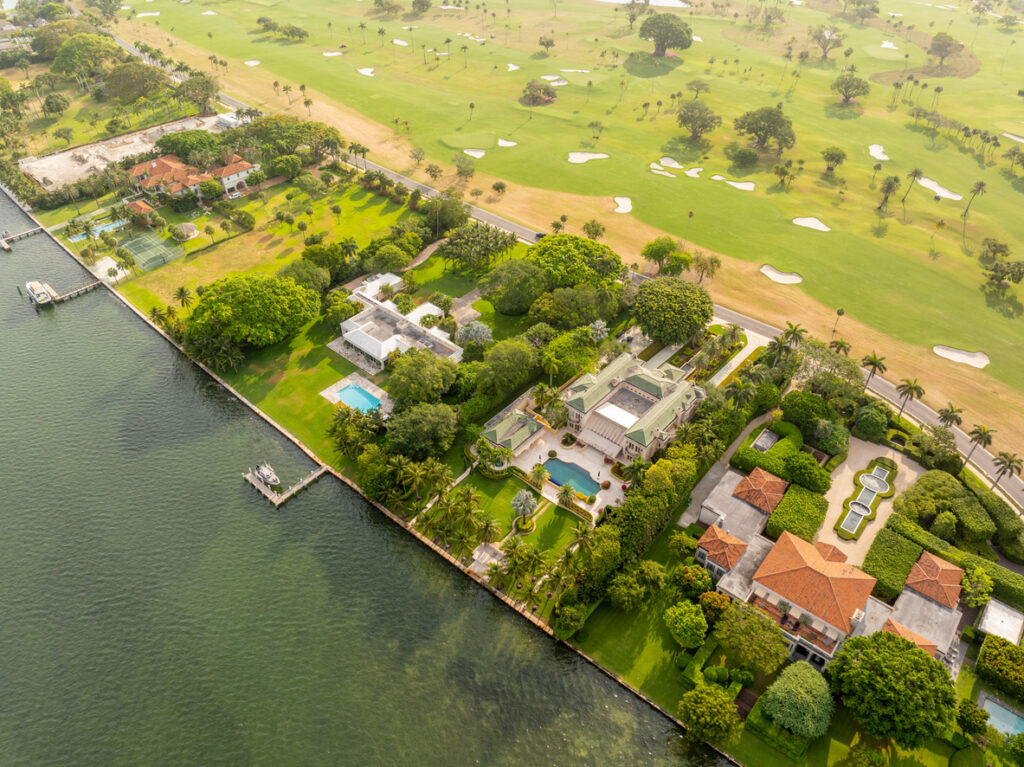
Here’s the wildest part about Mikhail Peleg’s Indian Creek Island sale: it’s just land. No house. No mansion. Just 1.8 acres of land on Miami’s Indian Creek Island – aka ‘Billionaire Bunker’ – and someone paid $105 million for it in June.
To be fair, this isn’t just any land. Indian Creek Island has exactly 41 properties, its own private police force, and is only accessible via one guarded bridge. Your neighbors include Tom Brady, Ivanka Trump, and Carl Icahn. And most importantly for this story: Jeff Bezos, who lives right next door and has been buying up the island like he’s playing Monopoly with real properties.
The seller was Mikhail Peleg, a Georgian-born businessman who is known as a successful gold trader and a luxury real estate investor who bought the lot in 2018 for about $27 million. Seven years later, Peleg flipped it for $105 million—that’s a $78 million profit, or a 290% return.
Despite his massive real estate deals, Peleg maintains an exceptionally low profile. Sources claim Peleg is on a first-name basis with tech titans like Mark Zuckerberg and Jeff Bezos himself.
The buyer’s identity remains officially undisclosed, though everyone’s first guess was obviously Jeff Bezos expanding his compound. The Amazon founder has been on a buying spree on the island, and this lot sits directly next to Bezos’ property.
The craziest thing? Mikhail Peleg’s bare lot sold for more than most completed mega-mansions in America. That’s the power of extreme scarcity and the right zip code. When there are only 41 possible addresses and your neighbor is the world’s second-richest person, apparently dirt becomes worth its weight in gold. Peleg’s sale demonstrates how strategic real estate investing at the ultra-luxury level can generate returns that dwarf traditional investments.
5. Hong Kong’s $140 million peak performance
While Americans were throwing around nine-figure sums, Hong Kong quietly notched its own ultra-luxury sale: a mansion at 1 Gough Hill Road on The Peak sold for about HK$1.088 billion, or roughly $140 million.
The Peak isn’t just a fancy neighborhood name—it’s literally on top of a mountain overlooking Victoria Harbour, and it’s been the most prestigious address in Hong Kong since colonial times. Living there is like living in a penthouse, except the entire neighborhood is the penthouse.
As is tradition in Asian ultra-luxury real estate, both the buyer and seller hid behind corporate entities, keeping their identities secret. Local reports suggested the buyer was connected to a mainland Chinese tycoon, but that’s about as specific as it gets.
What makes this sale interesting isn’t just the price—it’s the statement. Hong Kong’s real estate market has been struggling, caught between economic uncertainty and geopolitical tension. Yet here comes someone dropping $140 million on a house, basically saying “I’m not worried.” For Asia’s ultra-wealthy, The Peak remains the ultimate trophy address, market conditions be damned.
What the 2025 luxury real estate market reveals
- Beyond the shock value of nine-figure price tags from buyers and sellers like Mikhail Peleg, Alex Karp, and Eric Schmidt, these sales reveal something interesting about how the ultra-wealthy think about real estate in 2025.
- First, privacy is everything. Nearly every buyer—from Mikhail Peleg’s Indian Creek sale to the Naples deal—hid behind trusts, LLCs, or corporate structures. Apparently, when you have that much money, the last thing you want is people knowing where you live or what you own.
- Second, geography is diversifying. It’s not all Manhattan penthouses and Malibu beach houses anymore. Naples, Snowmass (where Alex Karp bought his monastery), Hong Kong—the wealthy are spreading out, seeking everything from tax advantages (hello, Florida) to pure seclusion (hello, Colorado monastery).
- Third, and perhaps most telling: several of these buyers are framing their purchases around something bigger than themselves. Eric and Wendy Schmidt want to host charity events at the Spelling Manor. Alex Karp supposedly cares about conservation. Nobody just says “I wanted a big house” anymore—there has to be a higher purpose attached, even if you’re dropping $100+ million.
- And finally, the math is just bonkers. Mikhail Peleg’s Indian Creek empty lot? He made nearly $80 million profit in seven years. The Naples estate? Even after a $70 million “discount,” it still sold for well above $200 million.
Welcome to luxury real estate in 2025, where the numbers stopped making sense a long time ago, but the spectacle remains endlessly entertaining.